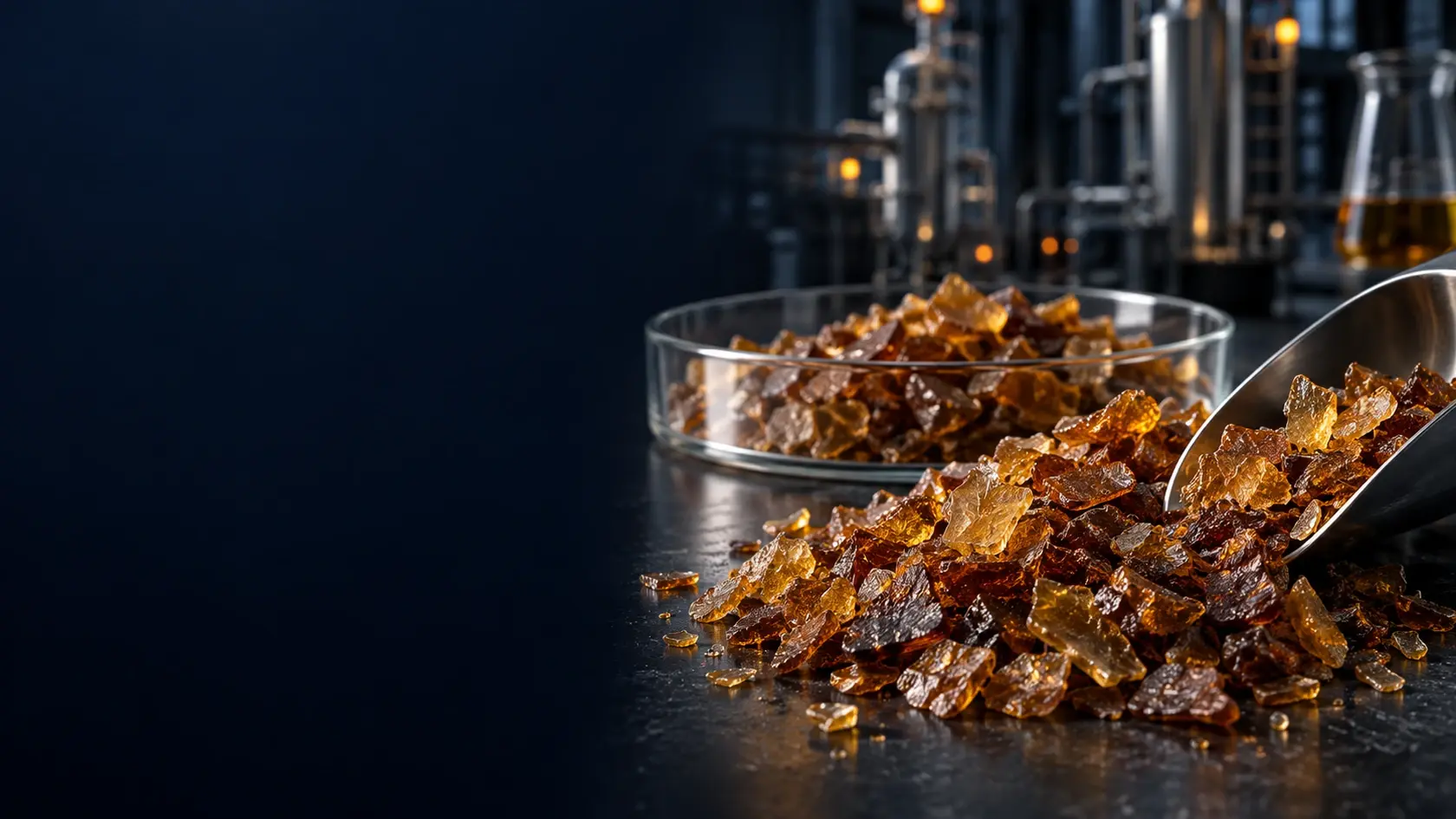
What is called a C9 hydrocarbon resin
Hydrocarbon resin C9 is a thermoplastic polymerization product of the aromatic part of petrochemical raw materials. In formulations, it can participate as a binder component, modifier of rheology, wetting or processing properties - the specific role depends on the matrix.
The C9 name describes a raw material family rather than guaranteeing the same behavior of products from different manufacturers. Colour, softening point, molecular distribution, volatile components, and compatibility may vary.
- Do not carry over a dosage from another formulation without a control sample.
- Compare products at equal non-volatile content and preparation conditions.
Key values in the CoA
The Gardner colour scale helps to assess the initial colour of the resin and its possible effect on the finished material. Softening point is a conditional indicator of behavior during heating according to the established method. It is not equal to the melting point or acceptable operating temperature of the product.
In addition, solubility, the mass fraction of volatile substances, ash, appearance and homogeneity are important. The set of methods and limits should be checked against the document of a particular batch.
- For Gardner, method, solvent and sample concentration are agreed upon; the photographic measurement is not a substitute.
- Softening is compared by one method; dissolution and mixing are checked under operating mode.
- Odour and possible inclusions are tested on the sample: zero probability cannot be promised.
Product applications
Piroplast-2K is considered for alkyd and protective coatings, rubber compounds, bitumen compositions, printing inks and a number of technical compositions. In each direction, the resin function and acceptance criteria change.
Indene-coumarone resin and SPS 5/9 form separate product branches. They can not be described as full synonyms C9: selected by task, available batch and test results.
- Coatings: compatibility, drying, gloss, adhesion and storage stability.
- Rubber: mixing, processing, vulcanisation and vulcanisate properties.
- Bitumen: dispersion, stability, softening point and low-temperature behavior.
- Casting and special composites: production cycle and testing of the finished product.
How to build a qualification
Start by describing the current material: matrix, grade, function, dosage, solvent, process temperature and finished-product properties. Then build a short list of candidates.
First prepare small comparative batches, then test them after conditioning and in pilot production. Estimate preliminary cost during selection and final economics from the confirmed dosage and process costs.
- Record the controls and criteria before obtaining the sample.
- Get the documentation for the proposed batch.
- Check multiple dosages, not a single dosage.
- Save samples and protocol for incoming inspection.
Main limitations
C9 aromatic resins should not be automatically positioned for colourless decorative materials with a strict water-white requirement. The characteristic odour of raw materials also requires evaluation in the finished system and after drying.
For melt adhesives, permanent stickiness adhesives, tapes and lamination, special requirements for colour, odour and compatibility are needed. The suitability of Piroplast for these tasks requires separate confirmation.
- For C9 Piroplast-2K resins, consider Gardner’s published 5–14 ranges by grade.
- Requirements for odour and inclusions are set taking into account the purpose of the finished material.
- Compatibility and dosage are checked against current raw materials.