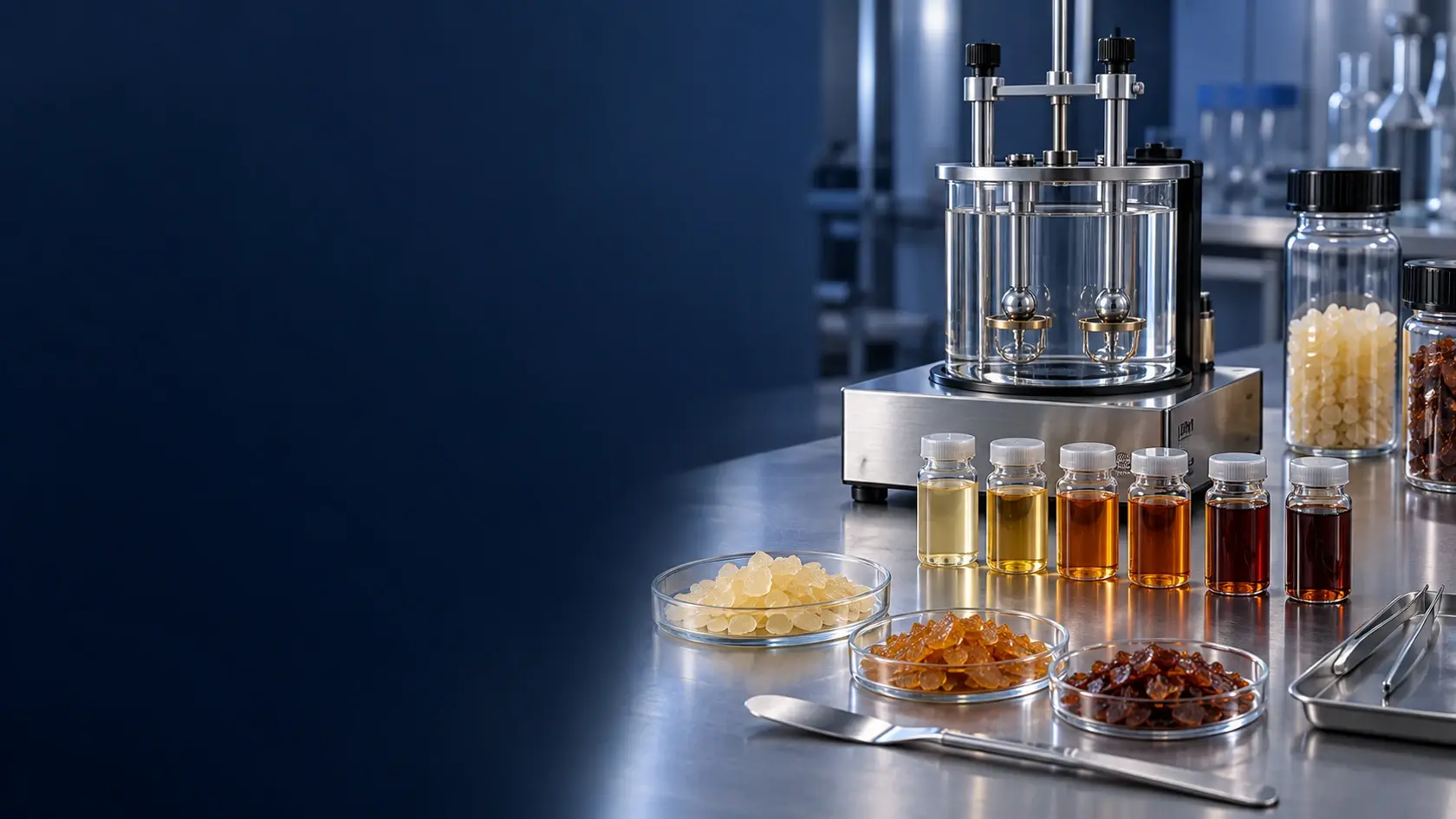
Step 1Finished productFirst determine its allowable colour
Step 2Process windowAddition, processing and service
Step 3CompatibilityMatrix and solvent
DecisionTest seriesControl plus several dosages
Step by step
From definition to qualification
Read consistently or move on to the right production issue.
Start by defining the finished material
The colour of the raw material is important only in the context of the formulation. The same resin may be acceptable in black rubber or pigmented primer and not acceptable in transparent varnish. Therefore, before the request, it is necessary to determine the measurable tolerance of the finished product.
A photograph of the resin on the screen does not replace the measurement method. Lighting, camera and background distort the shade. For purchase use the certificate of analysis for the batch and the control sample.
Specify the colour of the finished material and the method of its control.
Separate the mandatory limit from the desired one.
Evaluate the effect of dosage and other stained components.
What the softening point says
The softening point is not the melting point and not an independent guarantee of the heat resistance of the product. This is a comparative indicator of the behavior of thermoplastic resin when heated according to the established method.
A higher softening point can change the dissolution or mixing mode, viscosity, blocking and properties of the finished composition. The effect depends on the dosage and the entire matrix.
Compare the indicator with the maximum temperature of the process.
Check the time and completeness of dissolution or dispersion.
Measure properties after conditioning and ageing, not just immediately.
Relating colour to softening point
The numbers 10–30, 30–60 and 60–130 denote the colour ranges on the iodine scale. The softening point of the selected grade is agreed separately. The colour on the iodine scale should not be confused with the iodine number that characterizes unsaturation.
For the initial query, it is more useful for the technologist to specify an upper colour limit and a softening working range than to ask for an “equivalent grade” without describing the system.
10–30: Colour on the iodine scale; Gardner 5–8 on the catalogue
30–60: Colour on the iodine scale; Gardner 8–11 on the catalogue
60–130: Colour on the iodine scale; Gardner 11–14. Softening is agreed separately.
How to check compatibility
Even suitable colour and softening do not guarantee uniformity with the polymer, alkyd resin, bitumen or solvent. Incompatibility is manifested by clouding, precipitation or separation, change in rheology or deterioration of properties after storage.
The check is carried out in the real system, in the normal order of loading and temperature. Accelerated screening is useful, but the final conclusion is made on a full cycle.
Visual uniformity immediately and after exposure.
Viscosity and technology at the same temperature.
Properties of the finished coating, mixture or product.
From selection to delivery
Agree the grade specification and request the CoA for the sampled batch. When comparing Gardner, specify the solvent and the concentration of the sample, for softening - the method. Then try several dosages with a control formulation.
After the laboratory, conduct an industrial test. Consider the economy by work dosage, dry balance, losses and impact on the cycle - the price of a kilogram in itself does not show benefits.
Documentation → sample → laboratory series.
Protocol → pilot production → incoming inspection.
Preliminary calculation in the selection, final assessment - according to the results of tests.
Working matrix
Primary selection matrix
Use the table to structure your request, not as a ready-made formulation.
Indicator or situation
Production issue
Action.
Colour tolerance
Very light or transparent material
Consider a lighter branch or other class of resin; check the finished system
Colour tolerance
Pigmented or dark material
Compare actual Gardner batch and dosage effects
Process temperature
Limited heating
Check dissolution/dispersion of the selected grade
Operation
Risk of blocking or softening
Check the finished product under temperature load
Compatibility
New matrix or solvent
Mandatory laboratory screening and exposure
Documentation, sample and price
Create a short list of grades
Send the acceptable Gardner colour, operating temperature window, matrix, solvent and current product. We will start with the available batch, not with an abstract analogue.
Selection and calculationTo calculate the price and delivery, specify the grade, volume and destination. Technical selection is carried out in parallel.
Continue.
Related material
Product characteristics, recommendations for use and delivery conditions.
Which is more important: Gardner or softening point?
They answer different questions. Colour is related to appearance, softening is related to processing and thermomechanical behavior; both are needed and a compatibility test.
Is it possible to compare colour from a photograph?
No. The photo is suitable only for illustration; the decision is made according to the agreed method, the certificate of analysis for the batch and the sample.
The higher the softening, the better the resin?
No. A high softening point can complicate processing and does not guarantee the best properties of the finished product.
How to choose Piroplast-2K resins for dark primer?
Specify colour, solvents, preparation conditions and coating requirements. For dark primers, compare 30–60 and 60–130; for tighter colour limits, compare 10–30.
Why do you need documentation for each batch?
The catalogue shows the range and the documentation is the actual values for the material to be tested and delivered.
Can the current resin be replaced at the same dosage?
Just as one of the test points. Direct equality of properties and optimal dosage is not guaranteed.