Railway vehicles
Exterior surfaces of passenger carriages, locomotives and multiple-unit rolling stock.
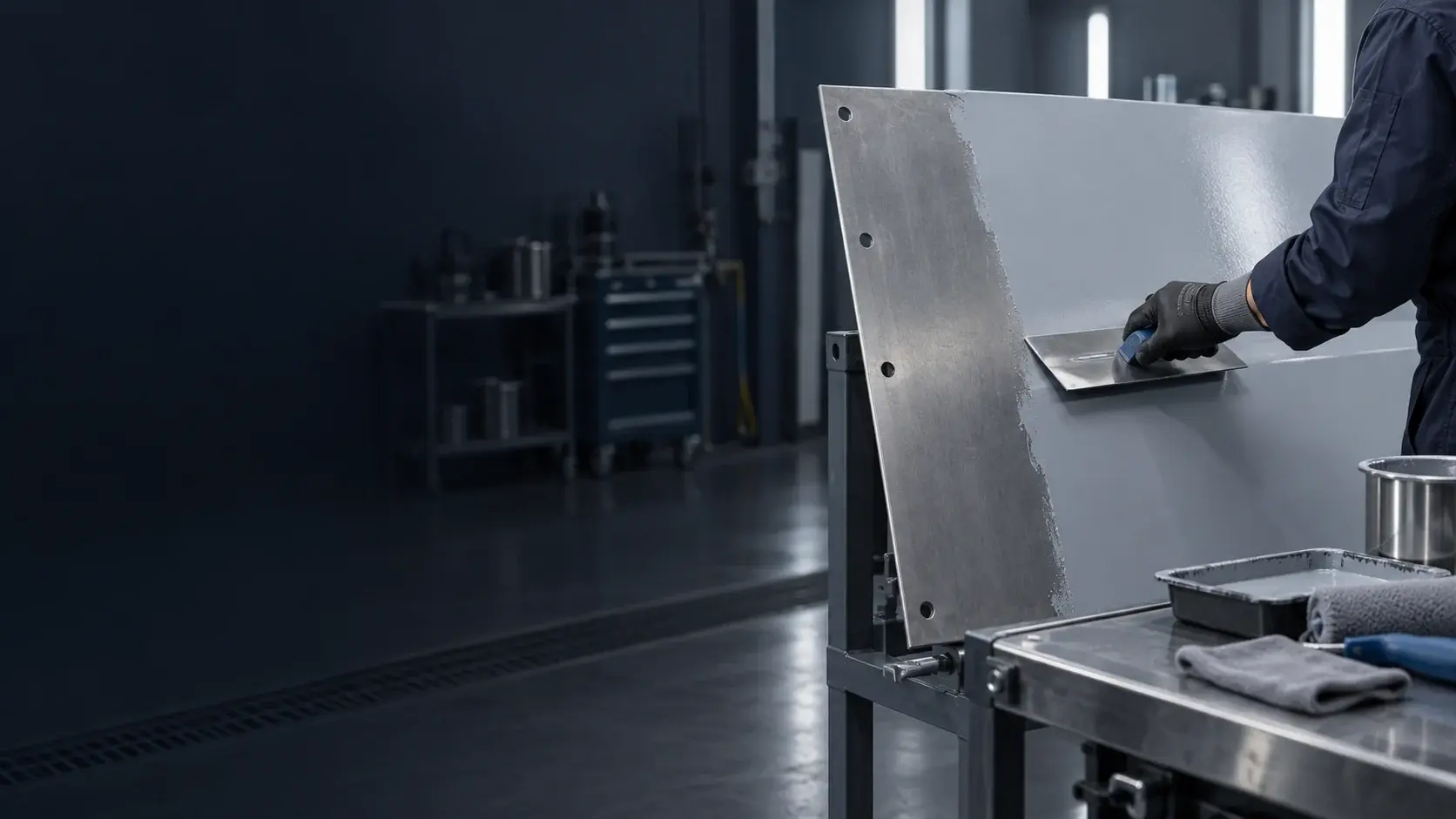
Ready-to-use paint or coating
An intermediate material that prepares the surface for enamel and clearcoat. Used in a protective and decorative system after metal preparation and priming.
About the material
Component A is an acrylic base with pigments and fillers; component B is a polyurethane hardener. The system description places this material between the epoxy primer and the decorative coats.
Material selection and the application process depend on the substrate, previous coats and service conditions. Request the current TU specification and instructions before use.
Purpose
The list is based on the AKRYL presentation. Suitability for a specific project is confirmed through technical selection.
Exterior surfaces of passenger carriages, locomotives and multiple-unit rolling stock.
Surface levelling in a system with the recommended primer, enamel and protective and decorative clearcoat.
The material can be requested separately. Its combination with other coatings must be agreed.
Specifications
Values are taken from the company presentation. Before ordering, check them against the current TU specification and the supplied material's quality documentation.
| Base-to-hardener ratio by mass | 20 : 4 |
|---|---|
| Pot life after mixing at 20 ± 2 °C | At least 3 h |
| Coating thickness | 60-70 µm |
| Non-volatile content by mass | At least 65 % |
| Drying to degree 3 at 20 ± 2 °C | No more than 8 h |
| Adhesion | No more than 1 point |
| Flexibility on bending | No more than 1 mm |
| Direct impact resistance | At least 50 cm |
| Water resistance at 20 ± 2 °C | At least 24 h |
| Resistance to 3 % NaCl solution at 20 ± 2 °C | At least 8 h |
| Working flow time, VZ-246(4) cup | 25-50 s |
| Thinning level | No more than 5 % |
| Time before sanding at 20 ± 2 °C | No more than 18 h |
| Theoretical consumption of the base for a two-coat film of 60-70 µm | 150-250 g/m², depending on colour |
| Drying to degree 3 at (60+2) °C | No more than 4 h |
| Time before sanding at (60+2) °C | No more than 6 h |
These are individual material specifications, not test results for the complete system. Requirements and test methods must be checked against current technical documentation.
Preparation
Identify the initial primer, surface condition and levelling requirements.
Mix the base and hardener at the ratio specified in the current TU specification before application.
Determine sanding, drying and enamel application using the procedure for the specific project.
| Component B | AKRYL 2K PU Hardener, TU 24.72.28-056-49740748-2025 |
|---|---|
| Thinner | PU Akryl, TU 20.30.22-055-49740748-2025; no more than 5 % by mass. |
| Mixture preparation | Stir the base and hardener separately first. After mixing, allow 10-15 minutes before application. |
| Application | Air or airless spray; two coats with a total dry film thickness of 60-70 µm. |
| Conditions | From +10 °C; relative humidity no more than 80 %; surface temperature at least 3 °C above the dew point. |
| Intercoat drying | 8 h; check the conditions for the specific project against the application instructions. |
This information is taken from the manufacturer's materials and does not replace the current application instructions. Request them for the selected material and project before application.
Theoretical consumption is given for the specified coating thickness. Actual consumption depends on application methods and conditions, roughness, object geometry and process losses.
Specify the object to be coated, substrate material, service conditions, required colour, area and application method. We will clarify technical documents and supply terms.
Questions
The presentation describes use over a previously primed surface and the possibility of a standalone coating. Confirm the specific procedure with the technologist.
The epoxy primer is shown as the initial material on metal. The primer surfacer prepares the surface for enamel.
The presentation uses both names with the same TU specification and values. We do not claim a separate product grade without clarification of the range.
In the tested system it follows the epoxy primer. The presentation also describes application to a surface previously primed with a polyurethane material; compatibility is checked for the specific procedure.
The presentation specifies at least +10 °C, humidity no more than 80 %, and substrate temperature at least 3 °C above the dew point.
The presentation table specifies up to 18 h at 20 ± 2 °C and up to 6 h at 60 ± 2 °C. Check the project's conditions against the TU specification.
The VNIIZhT conclusion covers a four-material system with the primer surfacer. A different procedure must be evaluated separately.
Catalogue